



As global trade evolves, one thing is becoming increasingly clear. Trade agreements alone are not enough. Digital trust must follow.
This was the focus of the latest Member Insights session hosted by the Cloud Signature Consortium on 24 March 2026, where members came together to explore the implications of the EU Mercosur Free Trade Agreement and to connect with organisations newly joining the CSC community.
A Shift in Perspective: Trade Depends on Trust
While the EU Mercosur agreement is often discussed in terms of tariffs, goods, and market access, the session invited participants to look at it from a different angle.
Guest speaker Jean Everson Martina, Associate Professor at the Federal University of Santa Catarina (Brazil), highlighted that behind every cross border transaction lies a more fundamental question. Can we trust the data, the documents, and the identities involved?
What are often described as non tariff barriers, such as compliance checks, certifications, and validation processes, are in reality trust challenges. They determine whether transactions can move efficiently across borders or become delayed, duplicated, and costly.
As trade becomes increasingly digital, these challenges become more visible. Verifying origin, ensuring integrity, and achieving legal recognition across jurisdictions are no longer optional. They are essential infrastructure for global trade.
From Insight to Action: Trust Without Borders
Building on this discussion, Daniel Rendon, CSC Board Member from SSL.com, and the Regional Partner of the Trust Without Borders Summit 2026, highlighted how these themes will be taken forward at the upcoming event.
Taking place in Bogotá, Colombia, on May 13th-14th, the CSC Summit will bring together regulators, industry leaders, and technical experts from across regions to address the very challenges discussed during the session. The focus will be on aligning regulatory frameworks and technical standards, strengthening interoperability, and enabling trusted cross border digital transactions at scale.
Members interested in continuing the conversation and engaging directly with this global ecosystem are encouraged to learn more about the Trust Without Borders Summit and explore the programme at www.cscsummit.com.
Different Starting Points, Shared Objective
The session also highlighted an important dynamic between regions.
In Europe, trust frameworks are typically developed through a regulation first approach. In many Latin American countries, large scale digital systems have already been implemented in practice, with standardisation evolving over time.
These different starting points can create complexity, but they also create opportunity. The EU Mercosur agreement is not only about connecting markets. It is about connecting trust frameworks and finding ways to make them interoperable.
Welcoming CSC’s New Members
The session also marked the introduction of several organisations newly joining CSC, reflecting the consortium’s continued global growth and diversity.
New members welcomed to CSC include:
These organisations bring expertise across digital identity, PKI, and trust services, contributing to CSC’s mission of enabling secure and interoperable digital transactions worldwide.
Continuing the Conversation
If one message stood out from the session, it was this. Digital trade will only scale if digital trust crosses borders.
CSC members are encouraged to continue the discussion through upcoming initiatives, working groups, and events.
A full recording of the session will be made available in the CSC Community member area for those who would like to revisit the discussion or share it with colleagues.
For questions, contact: info@cloudsignatureconsortium.org.
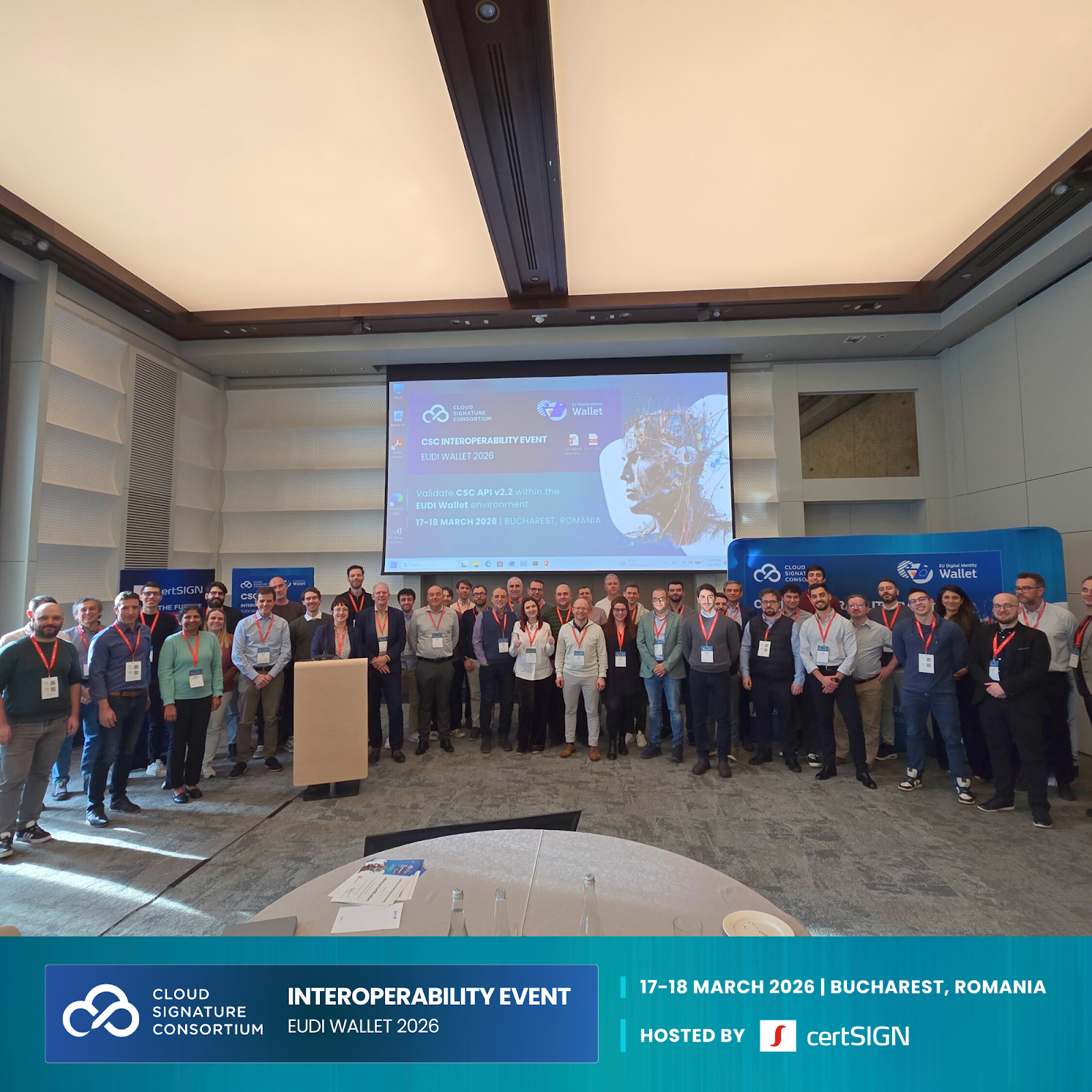
The Cloud Signature Consortium (CSC) successfully concluded its Interoperability Event 2026, held on 17–18 March in Bucharest and hosted by certSIGN. Bringing together EUDI Wallet providers, Qualified Trust Service Providers (QTSPs), and technology innovators from across Europe, the event marked an important step forward in advancing interoperability within the European Digital Identity ecosystem.
Over two days, participants moved beyond discussion to hands-on collaboration, testing real-world implementations of the CSC API within the EUDI Wallet framework. The programme combined strategic insights with deep technical engagement, covering remote signing use cases, API validation, and interoperability testing across multiple providers.
Day 1 focused on setting the context and technical groundwork, with sessions exploring the role of the CSC API in enabling secure, cross-border digital signatures. Participants then moved into environment setup and scenario planning, preparing for live testing.
Day 2 brought these efforts to life through live interoperability testing, cross-provider integrations, and real-world use case validation. Teams worked collaboratively to test, refine, and demonstrate their solutions, culminating in live demos and innovation showcases.
The event concluded with an awards ceremony recognising outstanding contributions. Intesi Group was named the winner of the CSC Interoperability Event 2026, highlighting their strong performance and commitment to advancing the CSC API ecosystem.
The Interoperability Event once again demonstrated the value of bringing the ecosystem together in a practical, testing-driven environment. As the European Digital Identity Wallet moves closer to large-scale deployment, initiatives like this play a critical role in ensuring technical readiness, alignment, and trust across stakeholders.
CSC extends its sincere thanks to all participants and to certSIGN for hosting the event in Bucharest.
The conversation continues at the upcoming Trust Without Borders Summit 2026 in Bogotá, where the global digital trust community will further explore the future of identity, signatures, and cross-border interoperability. Visit www.cscsummit.com for more information.
CSC Interoperability Event 2026 — In Numbers
95 plugtest registrations
3 with warnings
5 failed
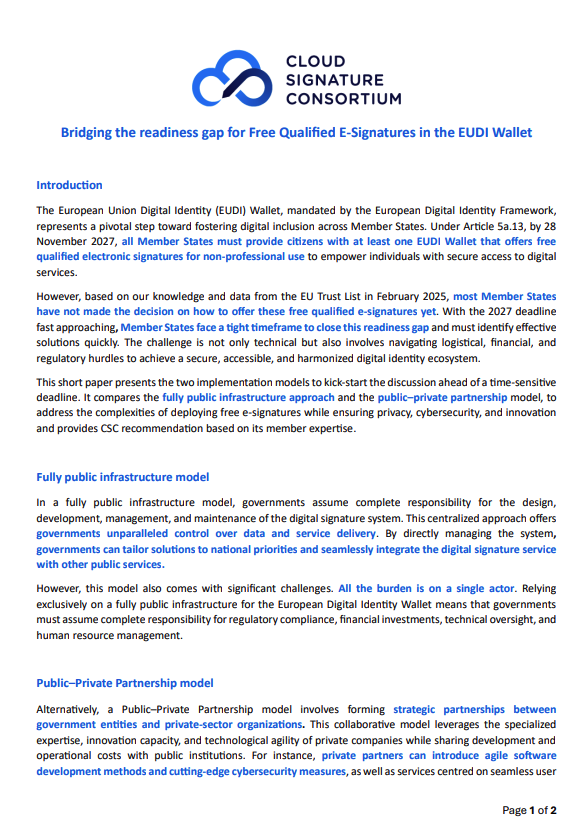
View the paper here: EUDI Wallet – How to implement Free QES by the Cloud Signature Consortium (CSC).pdf
This short paper outlines two possible implementation models for providing free QES in the EUDI Wallet, a fully public infrastructure or a public-private partnership.
While the paper is not for public distribution, we encourage you to share it with the relevant government experts you are in contact with, including those involved in the eIDAS European Working Group.
The aim is to help kick-start discussions ahead of the November 2027 deadline, by which all Member States must offer at least one EUDI Wallet with free qualified e-signatures for non-professional use.expectations.
BRUSSELS, Belgium – 3 June 2025 – The Cloud Signature Consortium (CSC), a global nonprofit dedicated to developing open standards for cloud-based digital trust services and promoting worldwide interoperability, announced the release of its “CSC Industry Market Report 2025 – The Cloud Signature Market: An EU & Global Perspective.” This comprehensive report, compiled by Obserwatorium.biz and NIMBUS on behalf of the CSC, provides an in-depth overview of electronic signature solutions and the evolving digital trust ecosystem worldwide, highlighting the impact of diverse legal frameworks and technologies on secure, cross-border digital interactions.
As e-signatures become increasingly essential in both public and private sectors, the report emphasizes the growing need for adaptable, standards-based solutions to meet regulatory demands and user expectations. The report analyzes the technical spectrum of e-signatures, ranging from traditional certificates on physical devices to cloud-based signatures that enable remote onboarding. It explores the pivotal role of cloud signatures in assuring cybersecurity, ensuring non-repudiation, and providing robust legal validation for modern digital interactions.
The report draws on original market research, including surveys and in-depth interviews with key market players from regions worldwide. These findings offer unique insights from practitioners who face the challenges, opportunities, and implications of implementing trust services every day. This approach highlights broad industry trends as well as the specific nuances of local markets and operational practices.
“This report underscores the critical importance of global interoperability in the digital trust ecosystem,” said Viky Manaila, President of the Cloud Signature Consortium. “As the world becomes increasingly interconnected, the ability to seamlessly and securely exchange digital signatures across borders is essential for fostering international commerce and collaboration. CSC’s mission to promote worldwide interoperability has never been more critical as businesses and governments accelerate their digital transformation.”
“The CSC Industry Market Report 2025 provides a comprehensive overview of the global cloud-based electronic signature market, with insights from both Europe and beyond. It examines the latest technologies, legal standards, and the rising role of cloud signatures in cybersecurity and regulatory compliance. What truly sets this report apart is the market research—surveys and interviews with industry leaders worldwide. Their input helped us capture global trends, local challenges, and opportunities. The result is a fact-based, practical view of the market’s current state and future directions.” said Miłosz Brakoniecki, co-founder and board member of Obserwatorium.biz.
Download the full report for free at: https://cloudsignatureconsortium.org/csc-industry-market-report-2025-the-cloud-signature-market-an-eu-global-perspective/
Join our Online Live Launch on June 10th from 2-2:30 PM CET:
https://zoom.us/meeting/register/AbkIA4RXRhmXbBexncAikg
About the Cloud Signature Consortium (CSC)
The Cloud Signature Consortium (CSC) is a global nonprofit association dedicated to developing open standards for cloud-based digital trust services and promoting worldwide interoperability. The CSC envisions a future where digital signatures are universally trusted and easily accessible, enabling secure and seamless digital interactions across borders and industries.Contact: Benita Lipps | info@cloudsignatureconsortium.org
This report has been compiled by Obserwatorium.biz and NIMBUS on behalf of the Cloud Signature Consortium (CSC), a global nonprofit dedicated to developing open standards for cloud-based digital trust services and promoting worldwide interoperability. It provides a comprehensive overview of electronic signature solutions and the evolving digital trust ecosystem worldwide, highlighting how diverse legal frameworks and technologies—from smartcards to cloud-based signatures—are shaping secure, cross-border digital interactions.
As e-signatures become essential in both public and private services, the report emphasizes the growing need for adaptable, standards-based solutions to meet regulatory demands and user expectations.
Download the full report to explore how countries and organizations can leverage cloud-based trust services to drive secure digital transformation.
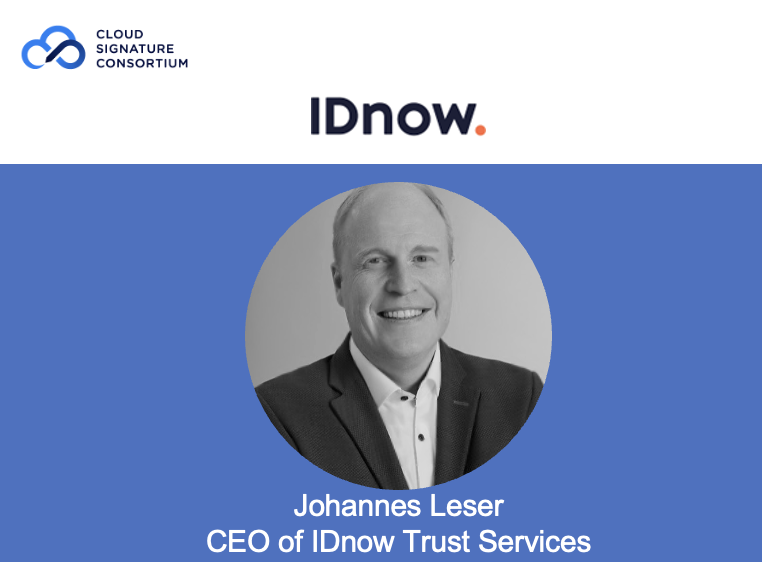
Cape Town, South Africa – April 2025 – The Cloud Signature Consortium (CSC) is pleased to announce the election of Johannes Leser to its Executive Board, following the Annual General Meeting held during the CSC Cape Town Summit.
Johannes joins the Board as the representative of IDnow, bringing valuable expertise in digital identity, remote signing, and trust services. His appointment reflects a continued commitment to strengthening the Consortium’s leadership and advancing secure, interoperable solutions across Europe and beyond.
With this addition, the CSC Executive Board continues to represent a diverse and dynamic group of leaders working together to shape the future of digital trust.
Click here for more information about our Executive Board and their contributions.

Cloud Signature Consortium VZW
Rue du Luxembourg 22-24 | BE-1000 Brussels
ID BE0687.882.032
Privacy PolicyCopyright © 2026 CSC - Developed by ALYS